
Your gutter may look perfectly fine on a dry day. Then heavy rain arrives, water starts spilling over the edge, joints begin leaking, and the ground around the building becomes flooded.
So, what went wrong?
In many cases, a gutter overflow or drainage problem is not caused by the gutter alone. The real issue may be an undersized downspout, blocked outlet, leaking connection, poorly supported gutter, or components that simply do not work well together.
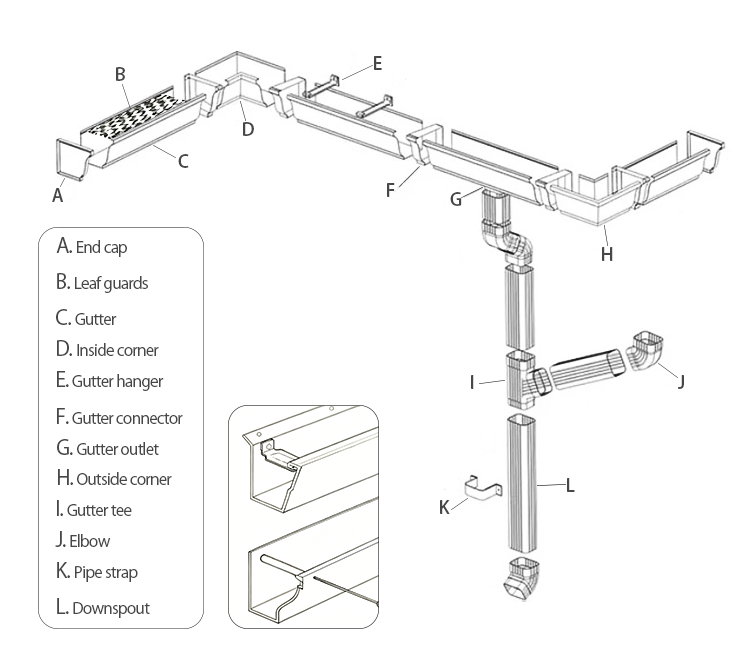
A reliable rainwater drainage system depends on every component working together, from the gutter and hanger to the end cap, connector, outlet, elbow and downspout.
In this guide, we will look at 7 common gutter problems, explain why they happen, and show what to consider when selecting gutter components for residential, commercial and industrial projects.

1. Why Is My Gutter Overflowing?
Gutter overflow is one of the most common drainage problems, especially during heavy rainfall.
When water flows over the front edge of the gutter instead of entering the downspout, several factors may be responsible.
Common causes include:
- Heavy rainfall exceeding the system’s drainage capacity
- Gutter size that is too small for the roof area
- Undersized or insufficient downspouts
- Blocked gutter outlets
- Leaves and debris inside the gutter
- Incorrect gutter slope
- Poorly positioned downspouts
A gutter system should be designed according to the roof area, expected rainfall and required drainage capacity.
Choosing a larger gutter alone does not necessarily solve the problem. The entire drainage path needs to be considered.
Gutter → Outlet → Elbow → Downspout → Drainage Point
If one component restricts the water flow, the entire system can be affected.
2. Why Is My Gutter Leaking at the Joints?
Gutter joints are another common source of leakage.
Even when the gutter itself is undamaged, water may escape where two sections are connected.
Common causes include:
- Poorly fitted connectors
- Incorrect component dimensions
- Damaged sealing areas
- Improper installation
- Thermal expansion and contraction
- Incompatible gutter profiles
A properly matched gutter connector should provide a secure connection between gutter sections while maintaining the required water flow.
For larger projects, component compatibility becomes particularly important. A connector designed for one gutter profile or size may not provide the same fit on another system.
This is why manufacturers and contractors should confirm the gutter profile, dimensions and material before selecting connectors.

3. Why Does Water Leak From the End of My Gutter?
An open or poorly sealed gutter end may seem like a small issue, but it can allow a significant amount of rainwater to escape.
This is where a gutter end cap plays an important role.
An end cap closes the open end of the gutter and helps prevent water from flowing out of the wrong direction.
A suitable end cap should:
- Match the gutter profile
- Match the gutter dimensions
- Provide a secure fit
- Maintain a clean finished appearance
- Work reliably under normal water flow
Different gutter systems may require different end cap designs. K-style gutters, half-round gutters and other profiles cannot always use the same components.
For OEM and project-based applications, customized end caps can also be manufactured according to specific dimensions and profiles.

4. Why Is My Gutter Sagging?
A gutter that starts to sag may not immediately look like a serious problem.
But once the gutter loses its intended slope, water can stop flowing efficiently toward the outlet. Standing water can then increase the load on the gutter and make the problem worse.
Common causes include:
- Insufficient gutter hangers
- Incorrect hanger spacing
- Weak mounting points
- Excessive water load
- Accumulated leaves or debris
- Snow or other environmental loads
Gutter hangers and brackets provide the structural support needed to keep the gutter in position.
The appropriate hanger type and spacing depend on the gutter design, material, building structure and expected load.
For this reason, choosing gutter hangers should not be treated as an afterthought. A well-designed drainage system needs both efficient water flow and reliable mechanical support.

5. Why Is Water Not Draining Into the Downspout?
Sometimes the gutter itself is not the problem.
Water may be collecting inside the gutter because it cannot enter the downspout quickly enough.
The gutter outlet is the transition point between the horizontal gutter and the vertical downspout. Its opening size, position and compatibility with the downspout can directly affect drainage performance.
Possible problems include:
- Outlet opening is too small
- Outlet is partially blocked
- Outlet position is incorrect
- Outlet and downspout dimensions do not match
- Debris has accumulated around the outlet
For high-rainfall areas, the outlet should be selected according to the expected water flow rather than simply based on appearance.
A properly matched gutter outlet helps create a smoother transition from the gutter into the downspout.

6. Why Is My Downspout Leaking at the Elbows?
Downspout elbows allow the drainage pipe to change direction and follow the structure of the building.
However, elbows can also become potential leakage points when components do not fit correctly.
Typical causes include:
- Incorrect elbow size
- Loose connections
- Poor alignment
- Damaged edges
- Incompatible downspout profiles
- Improper sealing
The elbow should match the downspout dimensions and profile to create a secure connection.
For projects requiring multiple direction changes, selecting compatible elbows in advance can make installation easier and reduce the risk of leakage.
This is particularly important for contractors and distributors purchasing gutter components in volume.

7. Why Does My Gutter Keep Getting Clogged?
Leaves, branches, dirt and other debris can gradually accumulate inside a gutter system.
When debris blocks the water path or covers the outlet, the drainage capacity can drop significantly.
A gutter leaf guard or leaf protection system can help reduce the amount of debris entering the gutter.
However, leaf protection does not eliminate the need for inspection and maintenance.
Regularly checking the gutter, outlet and downspout is still important, particularly before periods of heavy rainfall.
For buildings surrounded by trees, choosing an appropriate leaf protection solution can help reduce maintenance requirements and improve overall drainage performance.

Is Your Gutter Problem Actually a System Problem?
A gutter rarely works alone.
Reliable rainwater drainage depends on multiple components working together as one system.
A typical system may include:
Gutter
↓
Gutter Hanger
↓
End Cap
↓
Connector
↓
Gutter Outlet
↓
Elbow
↓
Downspout
↓
Rainwater Discharge
If one component is incorrectly sized, poorly connected or unsuitable for the application, the performance of the entire system may be affected.
This is why selecting gutter components individually based only on price can create problems later.
For contractors, distributors and OEM buyers, it is often more efficient to source compatible components from a manufacturer that can provide the required parts as a complete system.

How to Choose the Right Gutter Components
Before purchasing gutter components, consider the following factors.
1. Gutter Size and Profile
Different gutter profiles require different accessories.
Confirm:
- Gutter width
- Gutter depth
- Profile shape
- Connection method
This helps ensure that connectors, end caps and outlets fit correctly.
2. Material
The material should match the application environment.
Depending on the project, gutter components may be manufactured from different metals or other suitable materials.
Consider:
- Corrosion resistance
- Mechanical strength
- Outdoor exposure
- Expected service conditions
- Required appearance
3. Component Compatibility
A complete system should use components designed to work together.
Before ordering, confirm compatibility between:
- Gutter and connector
- Gutter and end cap
- Gutter and outlet
- Outlet and downspout
- Downspout and elbow
- Gutter and hanger
4. Installation Requirements
Consider how the components will be installed.
Different projects may require different:
- Hanger designs
- Connection methods
- Mounting structures
- Outlet positions
- Downspout configurations
5. Project Quantity
A homeowner replacing a few gutter components has different requirements from a distributor or contractor ordering thousands of pieces.
For larger orders, consistency between batches becomes especially important.

Custom Gutter Components for OEM and Project Applications
Standard gutter accessories may be suitable for many common installations, but not every project uses standard dimensions.
Custom manufacturing may be useful when you require:
- Non-standard gutter dimensions
- Custom end caps
- Special gutter connectors
- Different outlet sizes
- Custom hanger designs
- Specific profiles
- Custom colors
- Special packaging
- OEM branding
A manufacturer can produce components according to drawings, samples, dimensions or project requirements.
For OEM customers and distributors, this can provide greater flexibility when developing or supplying their own gutter drainage systems.

How Gutter Components Are Manufactured
Reliable gutter accessories begin with consistent manufacturing.
Depending on the product and material, the manufacturing process may include:
1. Material Preparation
Suitable sheet metal or other raw materials are selected according to the required specifications.
2. Cutting and Forming
The material is cut and formed into the required component shape.
3. Stamping or Bending
Specific components may require stamping, CNC bending or other forming processes to achieve accurate dimensions.
4. Welding and Assembly
For products requiring multiple parts, welding and assembly are completed according to the design.
5. Surface Treatment
Depending on the application, surface finishing may include coating, painting or other treatments designed to improve appearance and durability.
6. Quality Inspection
Finished components are checked for dimensions, appearance, connections and other specified requirements.
For large-volume OEM projects, maintaining consistent dimensions from batch to batch is just as important as producing the first sample correctly.


Why Work With a Gutter Components Manufacturer?
For contractors, distributors and OEM buyers, sourcing directly from a manufacturer can simplify the purchasing process.
Instead of purchasing each accessory separately, you can source multiple components from one production partner.
A capable manufacturer can support:
- Multiple gutter component types
- Different sizes and profiles
- OEM and ODM production
- Custom dimensions
- Custom colors and finishes
- Sample development
- Bulk production
- Packaging requirements
This can make it easier to maintain compatibility across the entire drainage system.

Need Gutter Components for Your Project?
Whether you are sourcing gutter accessories for a construction project, distributing rainwater drainage products or developing an OEM product line, choosing the right components can make a significant difference to installation and long-term drainage performance.
At RUICHI, we manufacture a range of gutter and rainwater drainage components, including gutters, hangers, end caps, connectors, outlets, elbows and leaf protection solutions.
With flexible manufacturing capabilities, RUICHI can develop custom sizes, profiles and specifications according to your drawings, samples or project requirements.
Send RUICHI your drawing, product sample, dimensions or project requirements. Our team can review your specifications and provide a suitable manufacturing solution and quotation for your project.



 English
 Spanish
 French
 Russian
 Portuguese
 German
 Arabic