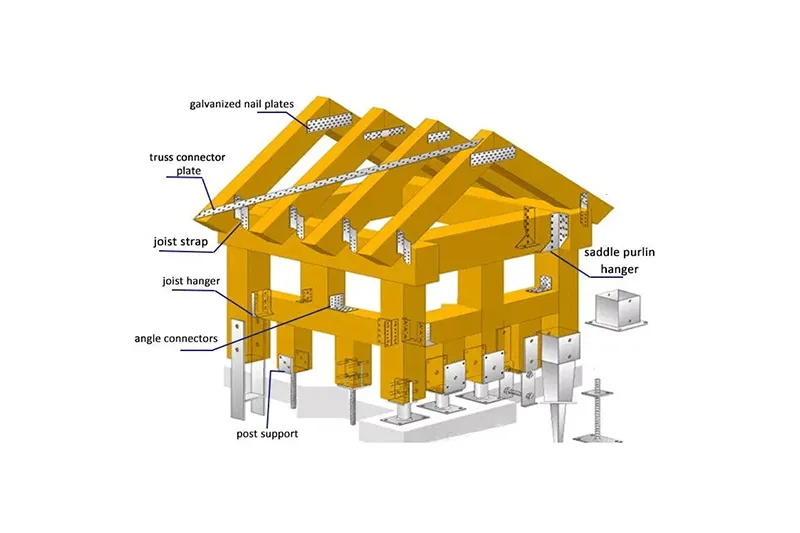
Weak wood connections can cause structural instability and costly repairs. Poor reinforcement increases safety risks. Nail plates provide strong, reliable support for durable wood house construction.
Nail plates are metal connectors used to reinforce wood joints in structural frameworks. They improve load distribution, strengthen trusses, and enhance building stability. Commonly used in roof and wall construction, steel nail plates and gang nail plates provide reliable fastening solutions for modern wood house connectors.
Understanding their functions helps builders improve structural safety and construction efficiency.

What are nail plates used for?
Nail plates are widely used in wood construction to reinforce and secure connections between structural members. A nail plate is typically a flat metal plate with multiple pre-punched teeth or holes that fasten into wood surfaces, creating a strong and stable joint. These connectors are commonly used in roof trusses, floor systems, wall framing, and other load-bearing structures.
One of the most common applications is the truss nail plate, which joins wooden truss components together. By distributing loads evenly across the connection point, nail plates help improve the strength and stability of the overall framework. In roofing systems, builders often use nail down the roof plates methods to secure structural sections effectively.
Steel nail plates are especially popular because of their durability and corrosion resistance. They are designed to withstand heavy loads and long-term environmental exposure. Gang nail plates and gang plate nail systems are also frequently used in prefabricated wood structures due to their high holding power and efficient installation process.
Overall, nail plates are essential components in modern wood construction, ensuring stronger joints and safer buildings.

Are nail plates stronger than nails?
Nail plates are generally stronger and more reliable than using nails alone because they distribute loads across a larger surface area. While individual nails provide point-to-point fastening, a nail plate reinforces the entire connection, reducing stress concentration and improving structural integrity.
A standard nail connection may loosen over time due to wood movement, vibration, or environmental conditions. In contrast, steel nail plates use multiple teeth or fasteners to create a more secure bond. This makes them highly effective in applications where high load-bearing capacity is required, such as roof trusses and floor systems.
Gang nail plates are specifically engineered to provide superior holding strength compared to ordinary nails. When pressed into wood, their teeth penetrate deeply and lock the components together. This improves resistance to pulling, twisting, and shifting forces.
In addition, angle nail plate designs provide extra reinforcement for corner joints and angled structural connections. These plates help maintain alignment and stability under heavy loads.
Although nails are still necessary in many construction tasks, nail plates significantly enhance the overall strength and durability of wood connections, making them an essential reinforcement solution.

When should you use nail plates?
Nail plates should be used whenever additional reinforcement is needed in wood construction. They are especially important in structural applications where joints must withstand significant loads or environmental stress. Common examples include roof trusses, floor joists, wall framing, and beam connections.
| Application Scenario | Nail Plate System/Type | Core Function & Benefit |
|---|---|---|
| Prefabricated truss manufacturing & roofing projects | Truss nail plate systems, steel nail plates (combined with nail down roof plates techniques) | Secure intersecting wood members, ensure stable load transfer throughout the structure; create stronger and safer roof assemblies |
| Repair of damaged wood structures | Nailing plates | Reinforce areas with cracks or weakened joints, restore structural stability |
| Regions prone to extreme weather (strong winds, earthquakes) | Gang nail plates, angle nail plate systems | Provide additional protection against structural movement, strengthen joints, improve building resilience |
Ultimately, nail plates should be used whenever a stronger, more durable wood connection is required, especially in load-bearing or safety-critical applications.

Where to install nail plates?
Nail plates are installed at critical connection points within wood structures where reinforcement is needed. The exact location depends on the structural design and application. Common installation areas include roof trusses, floor joists, wall studs, and beam intersections.
1. Roof Framing Systems
- One of the most common application locations for nail plates is roof framing systems.
- Builders nail down the roof plates to fasten the connection between roof trusses and supporting walls.
- Truss nail plate systems are generally mounted at joints where wooden truss members intersect.
2. Floor Systems
- Nail plates are applied to reinforce joist connections in floor structures.
- They enable even distribution of structural loads.
- Angle nail plates work best for strengthening corner joints and angled intersections.
3. Wall Framing
- Steel nail plates can be placed over vulnerable parts of wall framing.
- They effectively enhance the overall structural rigidity of walls.
4. Proper Installation Requirements
- Accurate positioning right over the joint is required for optimal performance.
- Fastening must follow standard recommended methods.
- Gang nail plates usually need hydraulic pressing equipment to guarantee full tooth penetration into wood.
Correct placement and installation ensure that nail plates provide optimal reinforcement and long-term structural stability.

Do I need nail plates?
Whether you need nail plates depends on the type of construction project and the structural requirements involved. In most modern wood construction projects, nail plates are highly recommended because they improve joint strength, stability, and safety.If the structure includes load-bearing components such as roof trusses or floor systems, using a nail plate is often essential. Truss nail plate systems are standard in prefabricated wood truss manufacturing because they provide reliable and consistent reinforcement.
Nail plates are also important for long-term durability. Without proper reinforcement, wood joints may weaken over time due to moisture, movement, or heavy loads. Steel nail plates help prevent these issues by maintaining secure connections.In renovation or repair projects, nailing plate solutions can strengthen damaged areas and extend the lifespan of the structure. They are also beneficial in regions with strict building codes or extreme environmental conditions.
Ultimately, while small non-structural projects may not always require nail plates, most structural wood construction applications benefit significantly from their use. They provide added safety, durability, and peace of mind.

Nail plates strengthen wood connections, improve structural stability, and enhance construction safety. Proper selection and installation ensure durable, reliable performance in modern wood house building systems.
Or further questions, please contact [email protected].