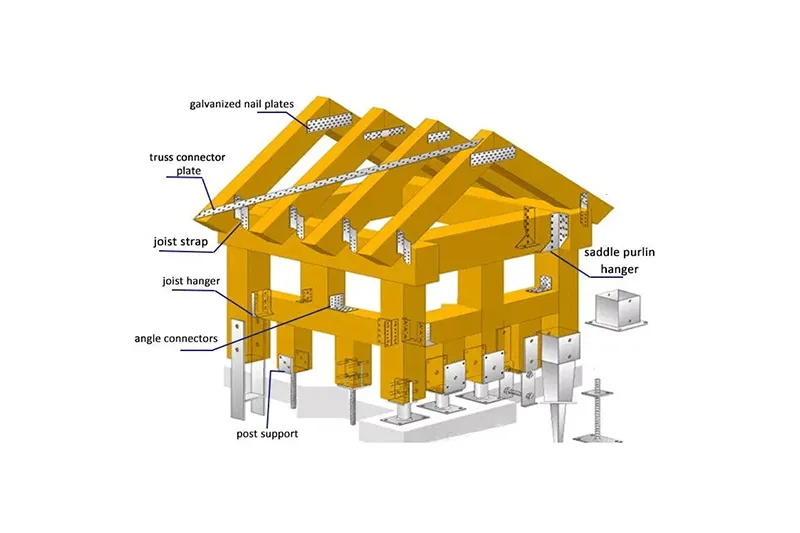
Weak structural connections cause floor instability and safety risks. This leads to structural failure and costly repairs. Joist hangers provide strong, reliable support for safe and durable wood construction.
Joist hangers are essential wood connectors used to support and secure joists in structural frameworks. They improve load distribution, enhance safety, and simplify installation. High-quality galvanised joist hangers, combined with proper nailing joist hangers techniques and correct spacing, ensure long-term durability in wood house construction.
Understanding their role helps ensure stronger and safer building structures.

What does a joist look like?
A joist is a horizontal structural member used in construction to support floors, ceilings, or roofs. Typically made from wood, steel, or engineered materials, joists run parallel to each other and distribute loads across a structure. In wood construction, joists are often rectangular beams with consistent thickness and depth, forming the skeleton of a floor system.
In most residential buildings, wood joists are spaced evenly and supported by beams or load-bearing walls. This spacing ensures proper load distribution and structural stability. Joists may appear as solid lumber pieces or engineered products such as I-joists, which provide enhanced strength and reduced weight.
Joists are usually connected using joist hangers and brackets, which secure the ends of the joists to supporting structures. Without proper connectors, joists may shift or weaken over time. In applications involving joist hangers for rough cut lumber, the hanger design must match the specific dimensions of the wood.
Understanding the physical structure of a joist is essential when considering how to fit joist hangers correctly, ensuring proper alignment and secure installation in wood construction systems.

What is the purpose of joist hangers?
The primary purpose of joist hangers is to provide a secure and stable connection between joists and supporting structures such as beams or walls. These metal connectors are designed to hold the joist in place while distributing loads evenly, preventing movement and structural failure.
Joist hangers eliminate the need for complex cutting or notching of wood, simplifying construction and improving efficiency. By using joist hangers nails or screws for joist hangers, builders can achieve strong and reliable connections without compromising the integrity of the wood.
In addition, joist hangers enhance structural safety by ensuring that loads are properly transferred. This is particularly important in modern construction, where precise engineering is required. Different types of joist hangers are available to suit various applications, including hurricane joist hangers designed to withstand extreme weather conditions.
Galvanised joist hangers are commonly used due to their corrosion resistance, making them suitable for both indoor and outdoor applications. Black joist hangers may also be used for aesthetic purposes in visible structures.
Overall, joist hangers are essential components that improve construction quality, safety, and efficiency in wood house building.

How safe are joist hangers?
Joist hangers are considered highly safe when properly selected and installed according to engineering standards. Their design allows them to support significant loads while maintaining structural integrity. However, safety depends on factors such as material quality, installation method, and load requirements.
Using high-quality galvanised joist hangers ensures resistance to corrosion, which is critical for long-term performance. In environments exposed to moisture or outdoor conditions, corrosion-resistant materials prevent weakening of the connectors.
Proper installation is also essential for safety. Nailing joist hangers correctly using specified joist hangers nails or screws for joist hangers ensures that the connector can تحمل the intended load. Incorrect fastening methods may reduce load capacity and increase the risk of failure.
In high-risk areas, such as regions prone to strong winds or earthquakes, hurricane joist hangers provide additional reinforcement. These specialized connectors are designed to resist uplift forces and improve structural resilience.
Regular inspection and maintenance further enhance safety. Identifying signs of wear or damage early allows for timely replacement, ensuring continued reliability. When installed and maintained correctly, joist hangers provide a safe and dependable solution for structural connections.

How much weight can one joist hanger hold?
The load capacity of a joist hanger depends on several factors, including its size, material, design, and installation method. On average, standard joist hangers can support loads ranging from several hundred to several thousand pounds, depending on specifications.
Manufacturers provide detailed load ratings for each product, which should always be followed. Factors such as wood type, joist size, and fastening method also influence the overall load capacity. For example, using the correct number and type of joist hangers nails or screws for joist hangers ensures that the connector performs as intended.
Different types of joist hangers are designed for specific load requirements. Heavy-duty hangers are used in applications requiring higher load capacity, such as multi-story buildings or commercial structures. In contrast, lighter hangers may be sufficient for residential applications.
Proper installation is critical for achieving the rated load capacity. Incorrect gutter hanger spacing—correction: joist hanger spacing—or improper fastening can significantly reduce strength. Ensuring correct alignment and secure attachment is essential.
Ultimately, understanding load requirements and selecting the appropriate hanger ensures safe and efficient structural performance in wood construction.

What are the four types of joists?
There are several types of joists used in construction, but four common categories include solid lumber joists, engineered I-joists, open web joists, and metal joists. Each type offers unique advantages depending on the application.
Solid lumber joists are the most traditional type, made from natural wood. They are widely used in residential construction due to their simplicity and availability. Engineered I-joists are designed for improved strength and efficiency, featuring a lightweight structure that reduces material usage while maintaining performance.
Open web joists consist of a truss-like structure, allowing for easy installation of utilities such as plumbing and electrical systems. These are commonly used in larger buildings where flexibility is required. Metal joists, made from steel, provide high strength and durability, making them suitable for commercial and industrial applications.
Each type requires compatible joist hangers and brackets for proper installation. For example, wood joist hangers are used for timber structures, while specialized connectors may be required for metal joists. Selecting the appropriate type ensures optimal performance and structural integrity.

Understanding these joist types helps builders choose the right combination of materials and connectors for their specific construction needs.Joist hangers provide essential support, safety, and durability in wood construction. Proper selection, installation, and maintenance ensure strong structural connections and long-lasting building performance.
Or further questions, please contact [email protected].