
A garage door does not arrive as a door. It arrives as four flat panels and one carton of hardware — and most of what goes wrong on site starts inside that carton.

The box has an order, not just a list
You cannot fit these parts in any order you like. Each step uses up the parts for exactly one joint, so the carton is packed in the order the joints are built.
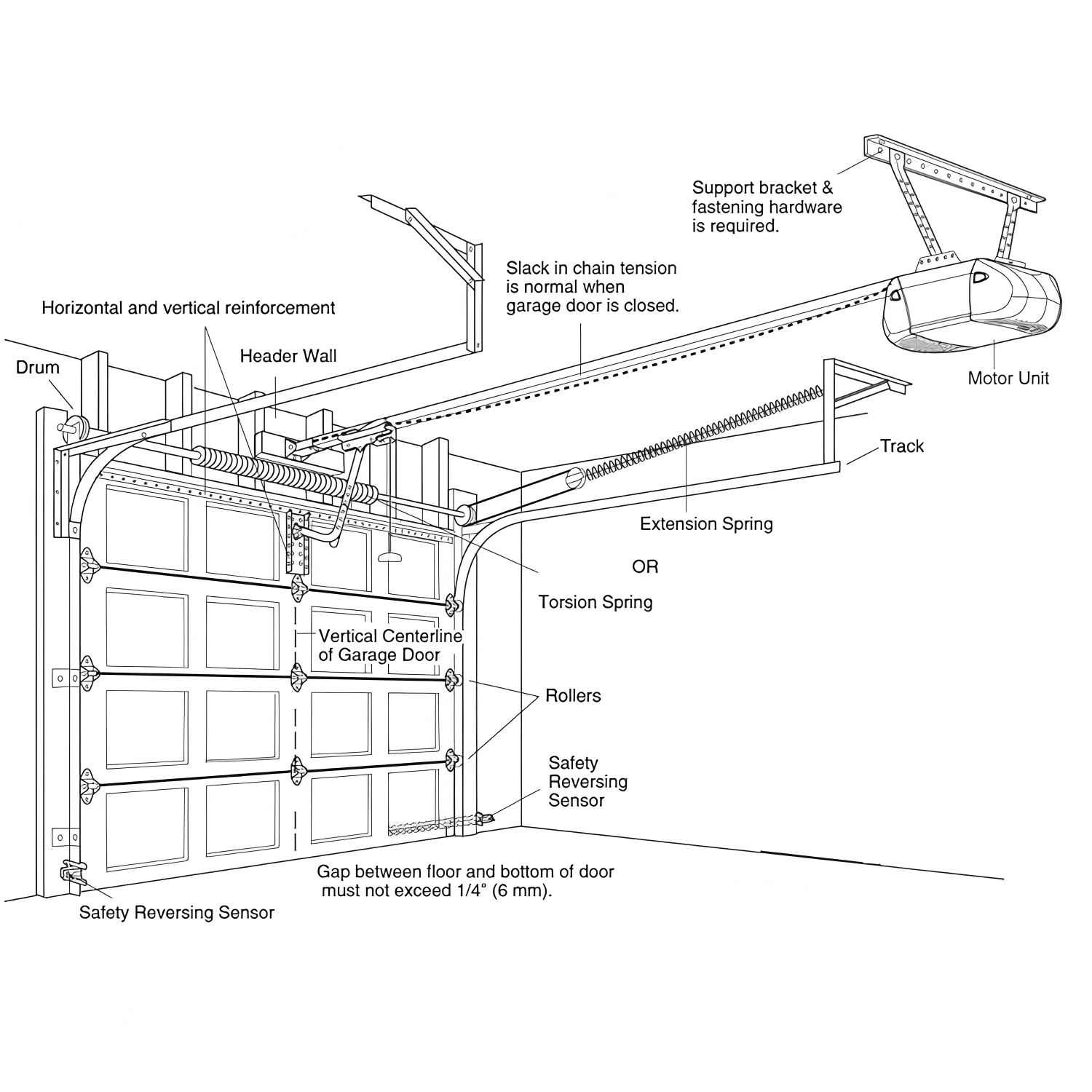
Bottom brackets go on first, because the lift cable ends there and nothing above can be set until that corner is fixed. Then the hinges at the lowest joint, then the next, then the top brackets that hold the top roller against the frame above the opening.
That order is why the mix of parts inside the carton matters more than the total. A carton that is right in total but wrong in the mix is worse than one that is plainly short: the shortage shows on the dock, the mix-up shows three joints up, when the fitter reaches for a part that is not there.

Why hinges are numbered 1, 2 and 3
The three hinges look almost identical. The number stamped in the leaf is the only thing that says which joint it belongs to.
What changes is the offset — how far the hinge holds the panel edge away from the track. At the bottom joint the door barely bends, so a flat #1 is right. As the door turns from vertical to horizontal each edge has to clear the curve, so #2 and #3 step it out further.
The difference is a few millimetres: same steel thickness, same finish, same hole pattern. Mix the bags and the fitter fits by eye. A #1 where a #3 belongs pulls the panel edge in, the door binds on the curve, the motor strains — and three weeks later comes the complaint about a door that was quiet on day one.

What a standard 8 × 7 kit holds
A standard kit for an 8 × 7 ft door holds 15 kinds of metal part and 7 kinds of fastener, 189 pieces in all. Nothing on that list is unusual. What matters is the third column — the part each line has to fit against, which no drawing gives you.

| Часть | Qty | Has to match |
|---|---|---|
| Nylon roller, 11-ball | 10 | 7/16 in. stem; track gauge |
| Hinge #1 | 5 | bottom joint; 14 ga |
| Hinge #2 | 2 | second joint |
| Hinge #3 | 2 | third joint |
| Top roller bracket | 2 | top roller; header gap |
| Bottom bracket | 2 | cable loop; panel corner |
| Jamb bracket #5 | 2 | jamb setback |
| Jamb bracket #6 | 2 | jamb setback |
| Flag bracket | 2 | track slot position |
| End bearing plate | 2 | shaft diameter |
| Cable drum | 2 | shaft; cable diameter |
| Lift cable, 8 ft | 2 | drum groove; door height |
| Lift handle | 2 | panel face |
| Centre support bracket | 1 | shaft; spring anchor |
| Bearing support | 1 | centre plate bore |
| Screw or bolt | Qty |
|---|---|
| Self-tapping, 7/16–20 × 1 in. | 90 |
| Lag screw, 7/16 × 2 in. | 20 |
| Carriage bolt, 1/4–20 × 5/8 in. | 16 |
| Tap bolt, 5/16 × 1 in. | 12 |
| Carriage bolt, 3/8–16 × 1 in. | 6 |
| Lag screw, 7/16 × 2-1/2 in. | 4 |
| Tap bolt, 3/8 × 1-1/2 in. | 2 |
| Total | 150 |
Add the two lists: 39 metal parts and 150 fasteners. Count the lines: 22. So when a supplier quotes one number — a weight, a price, “a set” — they have not told you which of the 22 is short.
The three lines that always come up short
Ask anyone who has been unpacking these cartons for years: the same three lines come up short.
- Screws and bolts.Counted by weight when packing. A scale that is two per cent out on 150 pieces is three screws missing from a bag that nobody opens until the last joint.
- Jamb brackets #5 and #6.They differ by a few millimetres of setback — how far the bracket sits back from the wooden frame — and by nothing you can see on a packing bench. That makes them the easiest pair to swap and to under-pack.
- Lift cables.Cut to door height. An 8 ft cable in a 7 ft carton is not something you fix on site; it is a return and a week.
None of the three is expensive, which is exactly why nobody checks them.

The twenty-minute check on the dock
Open one carton per pallet, not one per shipment. Then do five things, in this order.
- Count by part number, not by piece. Counting to 189 tells you nothing about whether the right 189 arrived.
- Read the hinge stamps. #1, #2 and #3 in separate bags, each matching its line on the list.
- Put #5 and #6 side by side. The setback difference is small, and it is the whole reason two numbers exist.
- Measure one cable against the door height on the order — not against the carton label.
- Weigh one carton. If it is light, open the others before you sign.
Twenty minutes on a dock against a stopped installation and a crew standing around: not a close call.
What we make, and what we do not
We stamp the parts that carry the tolerances: top roller brackets, нижние кронштейны, flag brackets, jamb and track brackets, L-brackets, reinforcement braces, perforated slotted angle, bottom corner brackets и lifting brackets — plus the hinges that sit between sections, numbered to your joint sequence, and the drums that set how the cable winds on.
We also coil torsion and extension springs, and build hardware to a line-by-line list for your door rather than a generic set. That is why our hardware kits are quoted by section count and stile spacing — where the vertical frame members sit at each panel edge — not by door size alone.
What we do not make: motors, safety sensors, weather seals, glazing. Those belong to the door system, and a carton that claims otherwise is selling you a phone call eighteen months out.
Buying the whole bracket family from one tool room is not about unit price. It is that the flag bracket slot, the jamb bracket setback and the hinge offset are set on the same press, to the same drawing revision, in the same week — and that somebody counts the pieces before the carton is sealed. For which bracket does what, see the bracket guide and the buyer’s guide.

Questions people ask before ordering
Do hinge numbers matter if the steel is the same thickness?
Yes. Thickness sets strength; the number sets how far the hinge holds the panel out. Two hinges of the same thickness from different joints will bolt on, then bind on the curve.
Can I use a #1 hinge where a #2 should go?
No. The door will close, but the panel edge will rub the track — the most common shortcut, and the one that turns a two-day job into a callback.
What changes on a 16 × 7 kit?
Roller and hinge counts roughly double and you gain centre hinges; brackets and fasteners go up with them, because there are twice as many hinge positions. Ask for the list, not a multiplier.
Do you supply the springs as well?
We coil them, but they are wound to the weight of the door. Send the panel weight and the drum size, not just the door size.
Can you pack to our own part numbers?
Yes — your numbering on the bag and on the carton label. Send the label layout with the order and we print to it.
Tell us the door. We will send back the full part list.
Send the door size, the number of sections and the stile spacing. We return the 22-line list for that door with the quantities filled in — the sheet we pack against. Put it next to what your carton claims and the gaps show up in four minutes.
RC Hardware · Cangzhou Ruichi Hardware · OEM/ODM stamping since 2009


 Russian
 English
 Spanish
 French
 Portuguese
 German
 Arabic