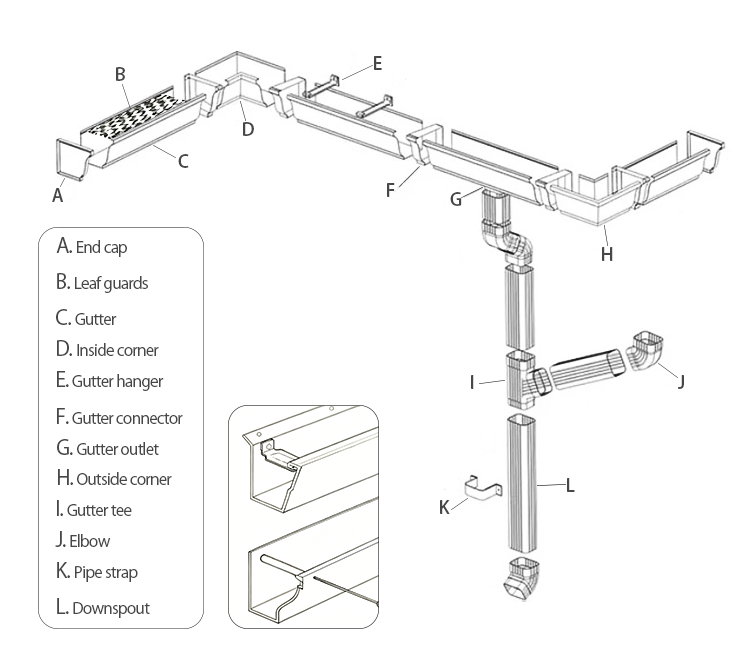
Leaves, pine needles, and other debris may seem harmless when they land in a gutter. The problem starts when they begin to build up.
Once enough debris collects inside the gutter, rainwater can no longer flow freely toward the downspout. Water may overflow over the edge, joints can become difficult to maintain, and regular gutter cleaning becomes another job that nobody particularly wants.
This is where gutter guards and other rain gutter coverings come in.
A properly designed gutter leaf guard helps keep leaves and larger debris out of the drainage channel while still allowing rainwater to enter the gutter. But do gutter guards really work? Are all gutter protection products the same? And how do you choose the right solution for different gutter profiles, materials, and installation conditions?
For homeowners, contractors, distributors, and gutter system suppliers, these questions matter because a gutter guard is not simply a cover placed over a gutter. Its opening design, material, dimensions, and installation method can all affect how effectively it handles rainwater and debris.
In this guide, we will look at how gutter leaf protection works, the common types of gutter guards, suitable materials, how to choose the right gutter guards, and what to consider when sourcing or customizing metal gutter guards for a project.

Do Gutter Guards Really Work?
Yes, a well-designed gutter guard can significantly reduce the amount of leaves, pine needles, and larger debris that enters a gutter. But it is important to understand what a gutter guard is designed to do.
A gutter protection system does not make a gutter completely maintenance-free. Fine particles, small seeds, roof grit, and other debris can still accumulate over time. The main purpose of a gutter leaf protection product is to reduce the amount of larger debris entering the drainage channel while allowing rainwater to pass through.
This is where the design of the guard becomes important.
Most rain gutter coverings use a perforated, mesh, screen, or specially formed surface. Rainwater passes through the openings and flows into the gutter, while larger leaves and debris remain on top or are directed away from the drainage channel.
The actual performance depends on several factors, including the opening size, material, gutter profile, roof condition, rainfall intensity, and surrounding vegetation. A gutter installed under large trees, for example, may collect considerably more debris than one installed on a roof with little vegetation nearby.
For contractors, distributors, and gutter system suppliers, this means choosing a gutter guard should not simply come down to whether the product looks good. The guard needs to match the existing gutter system and the conditions in which it will be used.
A good gutter protection solution can help reduce cleaning frequency, improve water flow, and lower the risk of leaves blocking the gutter or downspout. However, periodic inspection and maintenance are still recommended.
So, do gutter guards really work?
They can, when the design, material, dimensions, and installation method are properly matched to the gutter system. This is why understanding how gutter guards work is the first step toward choosing the right product.

What Are Rain Gutter Coverings and How Do They Work?
Rain gutter coverings are protective products installed over or along the opening of a gutter to help prevent leaves and larger debris from entering the drainage channel.
They are commonly used as part of a gutter protection system, particularly on buildings surrounded by trees or in areas where seasonal leaf fall can create frequent drainage problems.
The basic idea is simple: let water through while keeping larger debris out.
When rain falls onto the roof, it flows toward the roof edge and into the gutter. With a gutter covering or leaf guard installed, the rainwater reaches the protective surface and passes through its openings, perforations, or mesh structure.
Leaves, twigs, and larger debris are much less likely to enter the gutter because their size and shape prevent them from passing through the openings. Depending on the design, debris may remain on top of the guard or slide away from the gutter.
The opening design is therefore one of the most important parts of a gutter guard.
If the openings are too large, smaller debris can enter the gutter and eventually collect near the outlet or downspout. If the openings are too small, heavy rainfall may not pass through quickly enough, which can affect drainage performance.
The surface design also needs to work with the shape and position of the existing gutter. A guard that fits properly should remain stable while maintaining enough space for rainwater to enter the gutter.
For this reason, gutter leaf protection is not simply about covering the gutter. It is about controlling the path of water and debris at the same time.
For manufacturers, contractors, and distributors, details such as material thickness, opening size, overall width, profile, mounting method, and gutter compatibility can all affect the final performance of the product.
This is also why different projects may require different gutter guard designs rather than one universal solution.
A well-matched gutter covering can help keep the drainage channel cleaner, reduce the amount of debris reaching the downspout, and make routine gutter maintenance easier.

What Problems Can Gutter Guards Prevent?
A gutter guard is designed to address one of the most common problems in a rainwater drainage system: debris entering the gutter and restricting water flow.
Leaves are usually the most obvious problem, but they are not the only type of debris that can collect in a gutter. Pine needles, small twigs, seeds, roof particles, and other outdoor debris can gradually build up and create blockages.
Here are some of the problems that a properly selected gutter protection product can help reduce.
1. Gutter Blockage
When leaves and debris accumulate inside a gutter, they can form a layer that restricts the flow of rainwater. Over time, this may prevent water from reaching the gutter outlet efficiently.
A gutter leaf guard helps reduce the amount of larger debris entering the drainage channel in the first place.
2. Gutter Overflow
A blocked or heavily contaminated gutter may not be able to handle incoming rainwater effectively. During heavy rainfall, water can rise inside the gutter and eventually overflow over the front edge.
Keeping larger debris out of the gutter can help maintain a clearer water path and reduce the likelihood of overflow caused by debris accumulation.
3. Downspout Blockage
Leaves do not always stop inside the gutter. Smaller pieces of debris can travel toward the outlet and eventually enter the downspout.
Once debris accumulates inside the downspout, clearing the blockage can be considerably more difficult than cleaning the gutter itself.
A gutter guard helps reduce the amount of larger debris reaching the gutter outlet and downspout.
4. Frequent Gutter Cleaning
For buildings surrounded by trees, gutter cleaning may need to be performed repeatedly, particularly during periods of heavy leaf fall.
A suitable rain gutter covering can reduce the amount of debris that enters the gutter, potentially reducing the frequency of manual cleaning.
However, gutter guards should not be considered a completely maintenance-free solution. The guard itself may still need occasional inspection and cleaning, especially when fine debris accumulates on the surface.
5. Maintenance Problems Across the Drainage System
A gutter is only one part of a larger rainwater drainage system. If debris enters through the gutter, it can eventually affect outlets, downspouts, elbows, and other connected components.
This is why gutter leaf protection should be considered as part of the overall drainage system rather than as an isolated accessory.
The goal is simple: keep larger debris out while allowing rainwater to move efficiently from the roof to the gutter and then through the downspout.
For contractors, distributors, and system suppliers, this also means that the right gutter guard needs to match the gutter profile, drainage requirements, local weather conditions, and installation method.

Choosing the Right Gutter Guards for Your Gutter System
Choosing the right gutter guard is not simply a matter of selecting the product with the smallest openings or the strongest material. The best solution depends on the gutter system, roof conditions, local weather, and the type of debris the building regularly receives.
Here are several factors worth considering before selecting a gutter guard.
1. Gutter Size and Profile
The first consideration is whether the guard is compatible with the existing gutter.
Gutters are available in different widths and profiles, including common K-style and half-round designs. A gutter guard that does not fit the gutter correctly may move, leave gaps, or interfere with normal water flow.
For this reason, measure the gutter width and check the profile before ordering.
2. Type of Debris
Not every property has the same type of debris.
Large leaves may be relatively easy to keep out, while pine needles, small seeds, and fine debris can require a different opening design.
If a building is surrounded by large trees, the guard may need to provide greater protection against heavy seasonal debris. For areas with pine trees, a finer protective structure may be more appropriate.
3. Opening Size and Drainage Capacity
The openings in a gutter guard need to balance two requirements: keeping debris out and allowing enough rainwater through.
Very large openings may allow smaller debris to enter the gutter. Extremely small openings may become more easily covered by fine debris or restrict water entry during heavy rainfall.
The right opening design should therefore be considered together with the expected rainfall and surrounding environment.
4. Material and Thickness
The material affects the strength, corrosion resistance, appearance, and service life of the gutter guard.
Metal gutter guards may be manufactured from materials such as aluminum or galvanized steel, depending on the application and performance requirements.
Material thickness is also important. A guard needs enough rigidity to remain stable after installation without adding unnecessary weight or cost to the system.
5. Installation Method
A gutter guard should also be compatible with the intended installation method.
Depending on the design, products may be installed using clips, brackets, fasteners, or other fixing methods. The installation method should provide stable support while allowing the guard to follow the gutter profile correctly.
6. Local Weather and Roof Conditions
Rainfall intensity, snow, wind, roof pitch, and surrounding vegetation can all affect gutter protection requirements.
For example, a product designed for a mild climate with limited rainfall may not be the best choice for a project exposed to heavy rain or significant seasonal debris.
For contractors and distributors, considering these factors before ordering can help avoid compatibility problems later.
The goal of choosing the right gutter guards is not to find one universal product. It is to find a gutter protection design that fits the drainage system and performs appropriately under the conditions where it will be installed.

What Types of Gutter Guards Are Available?
Gutter guards are available in several different designs, and each type is intended to manage leaves and debris in a slightly different way.
There is no single gutter guard design that works equally well for every gutter, roof, and environment. The right choice depends on the type of debris, rainfall conditions, gutter profile, installation method, and required level of protection.
Mesh Gutter Guards
Mesh gutter guards use a fine mesh surface to allow rainwater to pass through while blocking leaves and larger debris.
The finer structure can provide good protection against smaller debris, but the mesh may require regular inspection if fine particles accumulate on the surface.
Screen Gutter Guards
Screen-style gutter protection products typically use a larger grid or screen structure.
They can be suitable for environments where the primary concern is larger leaves and general outdoor debris. Their relatively open structure can also provide good water entry when correctly matched to the gutter system.
Perforated Gutter Guards
Perforated gutter guards use a series of openings formed directly into a metal sheet or other protective material.
The opening pattern, size, spacing, and overall profile can be adjusted depending on the intended application. This makes perforated designs particularly useful when specific drainage and debris-control requirements need to be considered.
Metal Gutter Guards
Metal gutter guards are commonly selected when strength, dimensional stability, and long-term outdoor use are important considerations.
Aluminum and galvanized steel are two examples of materials that may be used for metal gutter protection products. The appropriate material depends on factors such as corrosion resistance, required strength, weight, finish, and project requirements.
Custom-Formed Gutter Guards
Some projects require more than a standard flat guard.
A custom-formed gutter guard can be produced with specific bends, edges, profiles, mounting sections, or dimensions to match an existing gutter system.
This can be especially useful for contractors, distributors, and OEM customers working with different gutter profiles or proprietary drainage systems.
The important point is that gutter guards are not simply interchangeable covers. Their structure needs to work with the gutter underneath.
For example, a guard with the right opening size but the wrong width may leave gaps. A strong metal guard with an unsuitable profile may not sit correctly. A fine mesh designed for small debris may also require a different maintenance approach than a perforated metal guard.
Understanding these differences makes it easier to select the right gutter leaf protection product for a specific project.


What Material Is Best for a Gutter Guard?
The best material for a gutter guard depends on the application rather than a single universal standard.
For outdoor rainwater drainage systems, aluminum and galvanized steel are two commonly considered materials. Each offers different advantages in terms of weight, strength, corrosion resistance, processing, and cost.
Aluminum Gutter Guards
Aluminum is lightweight and naturally resistant to corrosion, making it a practical choice for many residential and commercial gutter protection applications.
Its relatively low weight can also make handling and installation easier. Aluminum is well suited to forming and other sheet metal processes, which allows manufacturers to produce different widths, perforation patterns, bends, and profiles.
For projects where low weight and corrosion resistance are important, an aluminum gutter guard can be a suitable option.
Galvanized Steel Gutter Guards
Galvanized steel combines the strength of steel with a protective zinc coating designed to improve resistance to outdoor corrosion.
Compared with aluminum, galvanized steel generally provides greater rigidity and can be considered when additional structural strength is required.
It can be a suitable choice for projects where durability, stiffness, and cost need to be balanced.
Material Thickness Matters Too
Choosing the material is only part of the decision.
The thickness of the sheet can also affect the stiffness, weight, forming characteristics, and overall performance of the finished gutter guard.
A thicker material is not automatically better. Excessive thickness may increase material cost and weight without providing a meaningful benefit for the intended application.
The right specification should therefore be based on the gutter profile, installation method, expected environmental conditions, and required product performance.
Surface Finish and Outdoor Conditions
Because gutter guards are installed outdoors, surface condition and corrosion resistance should also be considered.
Depending on the material and application, customers may require specific surface finishes, coatings, or treatments.
For distributors and contractors purchasing gutter guards in larger quantities, it is useful to confirm the material grade, thickness, dimensions, finish, and packaging requirements before production.
Which Material Should You Choose?
There is no single material that is ideal for every gutter protection project.
Aluminum may be preferred when low weight and corrosion resistance are priorities, while galvanized steel may be considered when greater rigidity and structural strength are required.
The more important question is whether the material specification matches the actual installation environment and gutter system.
For OEM and wholesale projects, manufacturers can also help evaluate material options based on the required dimensions, profile, production method, target market, and expected order volume.


Are Gutter Guards Available for Different Gutter Sizes and Profiles?
Not every gutter system uses the same dimensions or profile, so a standard gutter guard may not always provide the right fit.
For contractors, distributors, and OEM buyers, this is one of the most important considerations when sourcing gutter guards.
A properly fitted guard should cover the gutter opening securely without leaving unnecessary gaps or interfering with the flow of rainwater.
Gutter Width
The overall width of the gutter guard needs to match the gutter opening and installation area.
Even a small dimensional difference can affect how the guard sits on the gutter. For larger projects, consistent dimensions across the entire production batch are also important for installation efficiency.
Gutter Profile
Gutters can have different shapes and profiles depending on the drainage system.
A guard designed for one gutter profile may not sit correctly on another. The supporting edges, bends, mounting sections, and overall shape may therefore need to be adjusted.
This is where a custom gutter guard can provide more flexibility than a standard off-the-shelf product.
Opening and Perforation Pattern
The opening pattern can also be customized according to the intended application.
Different hole shapes, sizes, spacing, and layouts can affect both debris protection and rainwater entry. The appropriate design depends on the type of debris, expected rainfall, and the requirements of the drainage system.
Edge and Mounting Design
The edge of the gutter guard is not simply a finishing detail.
It may determine how the product sits against the gutter and how it is secured during installation. Depending on the application, the guard may require specific bends, folded edges, clips, or mounting sections.
Length and Production Requirements
For wholesale and OEM orders, customers may also have specific requirements for product length, quantity, packaging, labeling, and production tolerances.
Instead of adapting the gutter system to a standard product, it can sometimes be more practical to manufacture the gutter guard around the requirements of the existing system.
This is particularly useful when a customer is developing a new gutter protection system or needs a replacement product that is not readily available from standard suppliers.
Custom Gutter Guard Manufacturing
A custom metal gutter guard can be developed according to drawings, samples, dimensions, or specific project requirements.
Depending on the product design, manufacturers can adjust factors such as:
- Overall width and length
- Material and thickness
- Perforation pattern
- Hole size and spacing
- Edge shape
- Formed profile
- Mounting sections
- Surface finish
For buyers looking for a gutter guard for sale in larger quantities, confirming these specifications before production can help ensure that the final product fits the intended gutter system.
The key is not simply finding a gutter guard that is available. It is finding one that is compatible with the system it needs to protect.


How Are Metal Gutter Guards Manufactured?
A metal gutter guard may look like a relatively simple component, but producing a consistent product requires more than cutting a piece of sheet metal.
For wholesale, OEM, and custom projects, manufacturing accuracy becomes especially important because dimensions, perforation patterns, profiles, and mounting sections need to remain consistent across production batches.
A typical metal gutter guard manufacturing process includes the following stages:
| Manufacturing Stage | What We Do | Key Quality Considerations |
|---|---|---|
| 1. Material Preparation | Select aluminum, galvanized steel, or other specified sheet metal according to the project requirements. | Material grade, thickness, surface condition, and overall consistency |
| 2. Cutting | Cut the sheet material to the required length and width. | Accurate dimensions, consistent width and length, clean edges |
| 3. Perforating / Opening Pattern | Create the required holes or openings using suitable sheet metal processing equipment. | Hole size, shape, spacing, pattern consistency, and drainage performance |
| 4. Forming & Bending | Form the flat sheet into the required gutter guard profile, including edges, support sections, and mounting areas. | Bending accuracy, profile dimensions, edge shape, and fit with the gutter system |
| 5. Quality Inspection | Inspect finished products according to the specified requirements. | Dimensions, opening pattern, forming accuracy, surface condition, and batch consistency |
| 6. Packaging & Shipment | Prepare inspected gutter guards for packaging and shipment according to the order requirements. | Quantity per carton, product labels, protective materials, and pallet arrangements |
For a gutter guard manufacturer, the manufacturing process is closely connected with product design.
The ability to control cutting, perforating, forming, inspection, and packaging within a coordinated production process makes it easier to manufacture gutter guards according to specific customer requirements.
For custom and OEM projects, buyers can provide CAD drawings, samples, dimensions, photos with measurements, or gutter profile requirements. These specifications can then be used to determine the appropriate material, opening pattern, dimensions, forming method, and production requirements.
The goal is not simply to produce one good sample. For wholesale and OEM orders, the same specifications need to be maintained throughout the entire production batch.
For buyers sourcing metal gutter guards, manufacturing capability is therefore just as important as the appearance of the finished product.


Why Source Gutter Guards Directly From a Manufacturer?
For small quantities, a standard gutter guard from a local supplier may be enough. But for contractors, distributors, importers, and OEM buyers, working directly with a gutter guard manufacturer can provide greater flexibility when product specifications and order quantities become more demanding.
Direct Communication
Working directly with the manufacturer allows buyers to discuss product dimensions, materials, opening patterns, tolerances, and installation requirements with the production team.
This can reduce misunderstandings when a project involves custom specifications.
Custom Product Development
A manufacturer can work with drawings, samples, dimensions, or existing gutter profiles to develop a custom gutter guard.
Instead of adapting the project to an available standard product, the product can be developed around the requirements of the drainage system.
Consistent Batch Production
For wholesale and distribution, consistency matters.
The width, length, perforation pattern, forming, and other specifications need to remain stable throughout production. A manufacturer with established production and inspection processes can better control these requirements across larger orders.
OEM and Private Label Support
For distributors and brands, gutter guards may need to be supplied under a specific product range or private label.
Depending on the project, manufacturers can support requirements such as product specifications, packaging, labels, quantities, and other OEM details.
Better Understanding of Production Costs
Direct communication with the manufacturer can also make it easier to understand how material selection, thickness, product dimensions, production methods, and order volume affect the final cost.
This is particularly useful when comparing different product specifications rather than simply comparing two finished-product prices.
Long-Term Supply
For businesses that regularly purchase gutter protection products, a stable manufacturing partner can be more valuable than finding the lowest price for a single order.
Consistent specifications, repeat production, quality control, and communication can help simplify future purchasing.
For these reasons, choosing a gutter guard supplier should involve more than checking a product catalog.
The right supplier should be able to understand the product requirements, manufacture consistently, communicate clearly, and support the project from the initial specification through production and shipment.


Need Custom Gutter Guards for Your Project?
Finding the right gutter protection product is not always about choosing a standard item from a catalog. When gutter dimensions, profiles, opening patterns, materials, or installation requirements are different, a custom solution may be a better fit.
RUICHI manufactures metal gutter protection products for contractors, distributors, and OEM customers, with support for custom dimensions, materials, perforation patterns, forming, and mounting designs.
Whether you have a CAD drawing, an existing sample, product dimensions, or simply a specific gutter profile you need to match, our team can review the requirements and discuss the appropriate production solution.
For wholesale and OEM projects, we can also discuss production quantities, quality requirements, packaging, labeling, and other project specifications.
Send us your drawing, sample, dimensions, or project requirements to discuss your custom gutter guard solution with RUICHI.